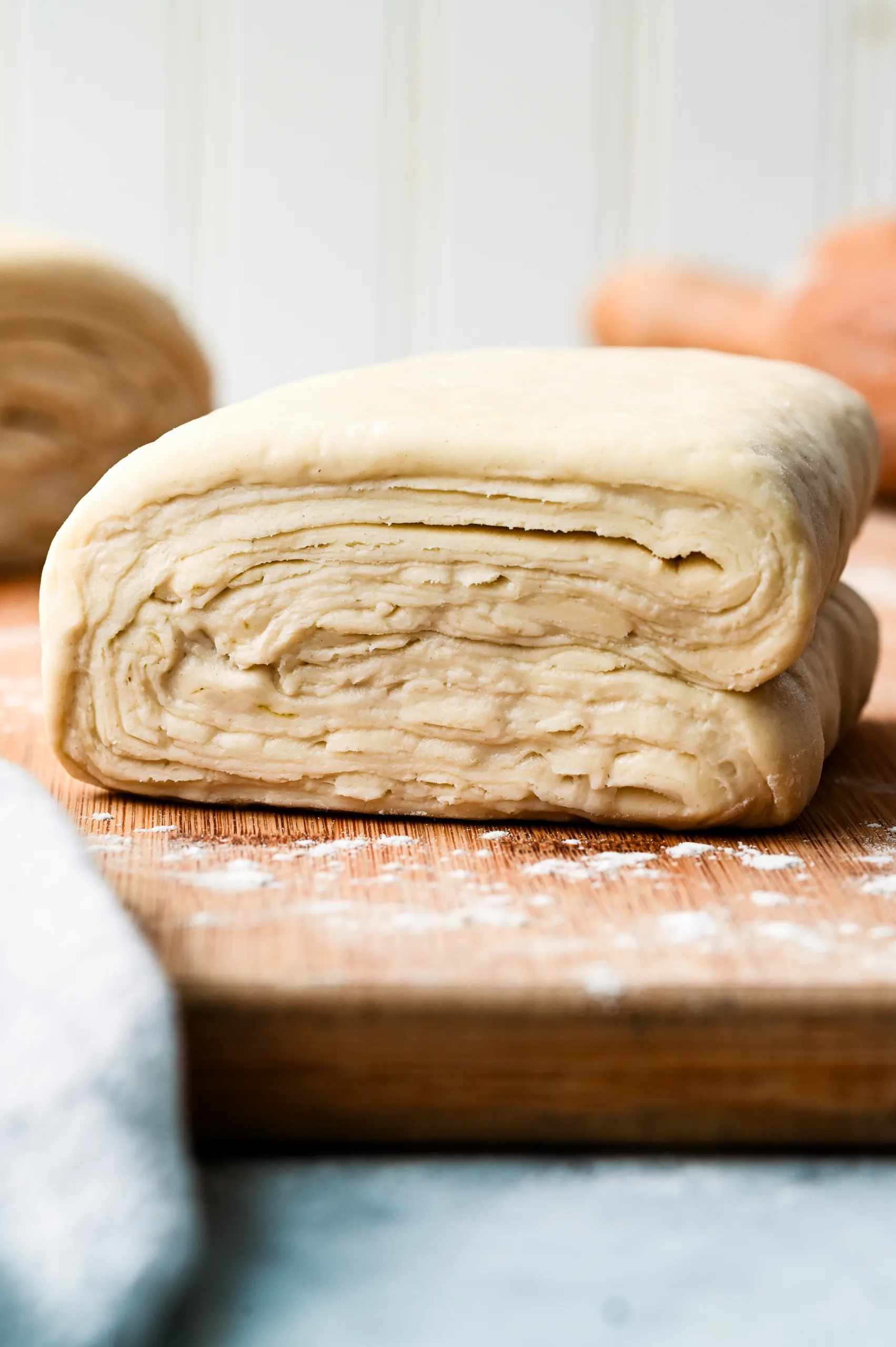
Traditional Homemade Puff Pastry Recipe (Classic Flaky Butter Layers)
This traditional homemade puff pastry recipe uses simple pantry ingredients and an old-fashioned lamination method to create flaky, buttery layers without any shortcuts. The dough is gently rolled and folded multiple times, allowing thin sheets of butter to form between layers for that classic puff when baked. While it takes a little time and patience, the process is straightforward and approachable for home bakers. The finished pastry bakes up light, crisp, and beautifully layered, perfect for both sweet and savory recipes.
Print
Pin
Servings: 2 batches
Equipment
- Large mixing bowl
- Measuring cups and spoons
- Rolling Pin
- Bench scraper or dough scraper
- Pastry brush
- Plastic wrap or reusable dough wrap
- Baking sheet
- Parchment paper
- Sharp knife or pastry cutter
- Refrigerator space for chilling
Ingredients
- 3½ cups all-purpose flour 500 g
- 1½ teaspoons salt 10 g
- 1 to 1¼ cups ice cold water 240–300 g, as needed
- 1½ cups unsalted butter 450 g, cold but pliable
- ¼ cup olive oil (55 g)
Instructions
- Reserve ½ cup of the flour to mix with the butter later. In a large mixing bowl, combine 3 cups of flour, oil, and salt. Mix by hand until you see little balls of oil in the flour.
- Add 1 cup of ice cold water and stir until a rough dough forms. Add more water little by little if needed.
- The dough should come together easily but should not feel sticky.
- Turn the dough out onto a lightly floured surface and knead gently for about 30 seconds, just until smooth. This is pastry dough, not bread dough, so avoid overworking it.
- Shape the dough into a circle. Wrap tightly in plastic wrap and refrigerate for 30 to 60 minutes to rest.
- Using a rolling pin, gently pound the cold butter to soften it. The butter should be cold but flexible. If it becomes too soft, return it to the refrigerator.
- With the reserved half cup of flour, sprinkle a good amount over the beaten butter.
- Begin pressing your palm of your hand into the flour to work it into the butter. This helps the butter spread easily without melting.
- Fold the butter over, and work the remainder of the flour in. Place to the side.
- Roll the chilled dough into a rectangle about 8 inches by 16 inches.
- Place the butter on one half of the dough, leaving a small border around the edges.
- Begin to spread the butter across ⅔ of the dough with a dough scraper or the palm of your hand, maintaining the small border around the edges.
- Fold over the ⅓ of the dough that does not have butter across the center.
- Then, fold the other ⅓ over the center, like a trifold.
- Lightly flour your surface and the top of the dough. Roll it into a long rectangle about 8 inches by 16 inches.
- After rolling the dough out, fold in one side to the half way point.
- Fold in the opposite side to the halfway point.
- Then, make a book fold by folding it in half. Cover it in plastic wrap and refrigerate the dough for 40-60 minutes. This will help it relax the gluten.
- After the dough has chilled, begin to pound it out with your rolling pin to help soften the dough. This will help to soften it so that the dough is easier to roll out.
- Start to roll the dough out to an 8 inch by 16 inch rectangle.
- Once rolled out, fold in ⅓ of the dough over the center.
- Then, fold over the opposite third over the center.
- Now, flip the dough vertically and begin to roll it again to a 8 inch X 16 inch rectangle.
- Fold one side of the dough to the center.
- Fold the other side of the dough to the center.
- Finally, make a book fold by folding in half. Wrap the dough and refrigerate for at least 1 hour.
- When ready to bake, roll the puff pastry dough on a lightly floured surface to your desired thickness, usually between ⅛ and ¼ inch.
- Handle gently and keep the dough cold. Always bake puff pastry in a hot oven, typically 400–425°F, so the butter creates steam and lifts the layers properly.
Notes
Helpful Puff Pastry Tips
- If butter breaks through the dough, lightly dust with flour, patch if needed, and chill
- If the dough shrinks while rolling, it needs more rest
- Puff pastry should always feel cold before baking